

 |
> Appraiser Coach > AMC Resource Guide > OREP E&O |
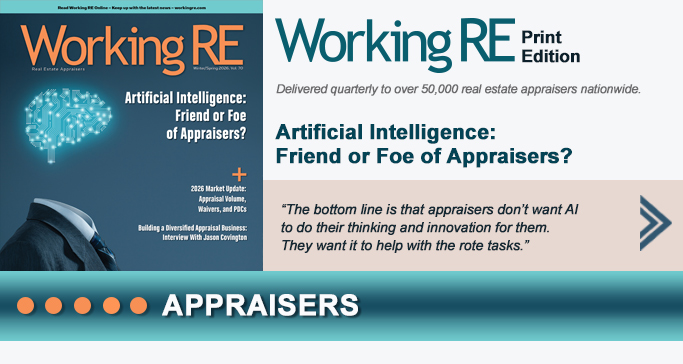
Artificial Intelligence: Friend or Foe of Appraisers?
by Isaac Peck, Publisher
Artificial intelligence is everywhere. It’s dominating headlines, boardroom conversations, and is being used in all kinds of professional and personal contexts—and appraisal is no exception.
Within the valuation community, AI has been discussed, debated, and sometimes feared for years. For some, it represents efficiency and opportunity. For others, it raises familiar concerns about automation, job displacement, and the erosion of professional judgment. The idea that “robots will replace appraisers” has become a recurring refrain even as appraiser licensing was just getting passed in the 1990s.
But setting aside the sky-is-falling rhetoric and the fearmongering, a more grounded question remains: what does the rise of AI actually mean for working appraisers?
How will AI change appraisal software? How will it alter workflow, analysis, and reporting? Where does it genuinely save time and where does it introduce new risks?
And from a more practical standpoint, can appraisers use AI today to run stronger businesses, work more efficiently, and increase profitability without sacrificing judgment, credibility, or compliance?
This article looks past the hype to examine how AI is already showing up in appraisal work, where it offers real value, where caution is essential, and what appraisers need to understand as the technology continues to evolve in 2026 and beyond.
Finding Practical Applications
“I’m using AI in every single appraisal I do.” Dustin Harris, the Appraiser Coach, was beginning his live stream Monthly Virtual Conference at TheAppraiserCoach.com, describing the current relationship between AI and appraisers. He described two factions: on the one side, he said, “some people are curious and want to know more,” and on the other side, “I’m not gonna say they’re scared of AI, but they don’t like the change. I don’t see many people in the middle.”
And that’s true. There are very few people who are neutral on this issue, inside or outside the appraiser profession.
Harris was direct about his approach to AI and how he thinks appraisers should approach it: “This is here to stay folks, and it’s going to be a big part of what we do as appraisers moving forward, honestly, whether we choose to or not.” His point is simple: AI isn’t a passing fad, it’s a permanent shift in how professional work will be done.
Getting Started
Roy Meyer, an appraiser with three decades of experience, as well as a business consultant and mentor for entrepreneurs, trains appraisers on how to use AI at www.AIforAppraisers.ai. “There’s not a single part of our appraisal business that AI doesn’t touch in some way, but it’s not replacing the appraiser. AI isn’t determining value. The appraiser is still in charge,” Meyer reports.
“Whether it’s client communication, setting up orders, market analysis, lead generation, you name it, AI can support it. Is there anything that AI doesn’t touch in how we operate? Not one thing.” Meyer’s emphasis is that AI is already woven into daily tasks, even if appraisers don’t always notice it.
“Appraisers who ignore AI are going to get blindsided,” Roy Meyer told me. “There’s plenty who think this is going away.” Meyer currently offers an AI training program for appraisers and consults on AI implementation with a variety of clients throughout the valuation space.
Meyer explains that the key to success with AI is learning how to have a conversation with it and using it as a strategic partner rather than an authority. “Once an appraiser understands that, there’s not a single area AI can’t help with: managing the business, marketing, diversification, building brand authority, strategic planning, streamlining workflows, creating SOPs, and more. But the analysis, judgment, and final value conclusion always stay with the appraiser.”
Meyer walked me through what it looks like to have an actual conversation with AI; to ask it questions, or to let it interview you by asking you questions, to gain clarity on your business. “You can simply tell ChatGPT what you want help with and ask it to guide you toward the outcome you want, whether you’re trying to solve a problem or accomplish a goal, while you remain the decision maker.”
Meyer went on: “Say, ‘Hey Chat-GPT, I don’t know anything about prompting, and I don’t know anything about AI. Help guide me on how I can improve my AI skills. Can you put a plan together with me to improve my AI skills?'” You can have the same type of conversation with it about your business, how to lower costs, increase revenue, and so on.
(story continues below)
(story continues)
From Software Efficiencies to Guardrails
While individual appraisers may experiment with AI in marketing, communication, and workflow, the way appraisal report software adapts to AI carries far greater implications. Reporting software sits at the center of valuation credibility, compliance, and risk. To understand how that core function may evolve and where automation still has limits, Working RE spoke with leaders at two of the largest appraisal report software providers, Bradford Technologies and a la mode (a division of Cotality). Their perspectives highlight where automation can genuinely help appraisers, and where guardrails remain critical.
Matt Krodel, real estate tech guru and principal project manager at Cotality | a la mode, sees promise in AI. “For appraisers, we’re focused on reducing the amount of labor needed for tasks that may not require specialized appraiser skills. I’m thinking data entry and straight facts and information,” says Krodel. There are also diagnostic and exploratory functions. “Take a picture of a room and even a non-specific AI now can tell you what the walls and ceilings are made out of, how high the ceiling is, and all the things that the new URAR needs to know about that room,” he said. This is a big change from a few years ago, when appraisers “needed specially trained image analytics for this type of thing.”
One of the most important shifts, and one which is commonly ignored in the doomsday scenarios, is the shift to appraisers having more time to do higher level analysis, since much of the busy work will go automated. “Appraisers will be spending more time on analysis, analytics, and market reporting, because there won’t be so much manual work to get a report done,” said Krodel. And that’s a scenario that reflects what is best about automation: freeing professionals to focus on judgment, insight, and expertise rather than repetitive tasks.
Jeff Bradford, founder and CEO of Bradford Technologies, says his firm is proceeding with a cautious approach to AI, but still sees potential for AI to assist appraisers in a variety of tasks. “Appraisers can be the architects of the valuation. AI is just an assistant,” Bradford said. In other words, the human expert still designs the process, but AI helps carry the load.
The conservative view, the fear of AI, is partly based on one very practical and immediate concern: AI is frequently inaccurate and misleading. Large language models (LLMs) “hallucinate,” meaning they sometimes generate information that looks convincing but is simply made up.
“We’re taking a very conservative approach to integrating AI into our software,” Jeff Bradford told me. “I was on a podcast with Dustin Harris and all the people on the Panel at the 2025 ValExpo were gung ho about AI, and I was the only one that was conservative.” Bradford’s caution reflects a broader worry: appraisers cannot afford errors in their reports.
“Because AI can hallucinate, can make things up, it may add more work for the appraiser to verify the results. What AI brings back, for the appraiser who doesn’t do the verification, could cause problems. So we’re taking a pretty conservative view. Whatever we add in, we want it to be very straightforward, where it is almost impossible for it to make something up. One example I’ve been telling people about is having AI read the sales contract. The appraiser gets the sales contract and extracts out the contract price, date, and if there were any concessions. You can program an AI Agent to specifically look at those documents and extract the information, but then also highlight where they got the information in the PDF. Reading the contract might be a 10 to 12‑minute job. If you give it to an AI, then it turns into a five‑second process. That’s a big savings.”
Even then, Bradford stressed that the appraiser must verify the extracted information against the highlighted source text before it ever enters the workfile or the report.
“People are relying on that valuation. The bank wants to lend money, the borrower wants to borrow the money, Fannie Mae wants to do what it does, and you cannot have hallucinations showing up in there that get missed. It could be very damaging. Appraisers could lose their licenses or get sued.”
Krodel echoes Bradford’s concerns. “AI is not afraid to spit out wrong answers,” he said. “It always wants to give you an answer. It’s getting better all the time, but you do need to check the work.”
But the bottom line is that appraisers don’t want AI to do their thinking and innovation for them. They want it to help with the rote tasks. “We want it to do things that are very structured, simple, and with good guardrails,” Bradford said.
Understanding limits also helps: AI can process existing information, but it can’t generate new information. For appraisers, that means it’s more helpful for organizing than creating. “AI is really good at distilling down the main points of something,” Krodel said. “Those are places appraisers can use it. Some may disagree with me, but I feel the tech still has a little ways to go before it can do actual analytics.”
“Appraisers might say ‘oh, well good enough.’ Pretty soon they’re talking to the regulatory board about their made‑up comp,” Bradford warned. “I was talking to a guy who does commercial appraising. He went and asked ChatGPT to do an analysis, bring in all these sales, look at a boatload of data. Then he looked at me and said: ‘I have no idea if this is correct or not.'”
“It’s like attorneys getting flagged for citing fake cases,” Bradford said. “You don’t want fake judgments, fake data, fake analysis.”
From a risk-management standpoint, Krodel said data security is paramount. He explained how his company used AI to program their Cotality product. “With Cotality, we have our own internal instance of AI, different than a generic ChatGPT,” he said “All the stuff is secure. Anything we put up there is not going out into the universe to train other AIs.”
(story continues below)

(story continues)
Hopeful Futures
While today’s tools are still imperfect, industry leaders see enormous potential for technology to reshape the way appraisers work. Their overriding belief is that AI will not replace appraisers, but rather expand their capabilities, automate routine tasks, and open new horizons for analysis and efficiency.
“Where it’s going to get really, really interesting is when AI starts to understand 3D,” Bradford said. “This is where robots come in. There is a lot of work in AI spatial analysis that is being done. Now imagine, you take a bunch of pictures, give it to AI, it’s going to draw your floor plan for you, it’s going to extract all the details of the property, it’ll select the best photos for inclusion in your report. These are the photos that best represent the property. It’s going to be a fascinating time in the future. We’re just at the very, very beginning of all this.”
He envisions a scenario where AI can triage appraisal jobs. “When an appraisal job comes up, can an AI be trained to analyze that property and determine if it’s a complex property, simple property, condominium, two-four unit, etc. and then based on what it finds, create the steps that the appraiser should go through to determine the value? That would save everybody a lot of work.”
Just like Meyer said that experiential learning about AI should be a top priority for appraisers, Krodel advised experimentation. “Be proactive, using it in an unintegrated mode,” he said. “Run your comments from your appraisal report through it. Just to see what it says. Get a general experience with it. Try it out.”
Krodel sees future developments as dependent on which of the “different flavors of AI” professionals prefer. “Some people would consider things like AR scanning of properties as a form of AI. A lot of that automation, where you see something visually and turn that into data in a report, is going to accelerate,” he said. “There will be less translating what you see with your eyes into input. That way the appraiser can focus on analyzing it.”
“I don’t think AI is going to replace appraisers at all,” Krodel told me. “It’s just going to make appraisers’ lives a little easier by doing some of the work for you.” Companies like a la mode and Bradford are helping make that happen.
Liability
As appraisers experiment with AI, liability is one of the least discussed—but most consequential—parts of the conversation. While AI can streamline certain tasks, it also introduces new risks when appraisers rely on outputs they haven’t fully reviewed or verified. Some newer software providers are making bold claims that appraisals can be completed in “just a few minutes” using automated tools. The danger is simple: regardless of how fast the technology works, the appraiser remains responsible for every data point, every conclusion, and the risk that comes with the report.
Brianna Walker, Senior Underwriter at OREP Insurance, says that’s where claims will arise with AI. “What we see isn’t usually about the tool itself—it’s about how it’s used,” Walker explains. “AI can make it easier to move quickly, but it can also make it easier to miss errors if appraisers assume the technology is always right or is doing the thinking for them. If you’re using AI to auto-fill sections of your reports, double checking it is so important. From a liability standpoint, the appraiser is still on the hook, regardless of how the information was produced.”
As an E&O provider insuring more than 10,000 appraisers nationwide, OREP is often among the first to see how new technologies translate into real-world claims and complaints. “We have concerns that some appraisers will use AI to plug in data without checking it,” Walker says. “Verification is non-negotiable.” OREP expects to issue additional guidance as AI-assisted workflows become more common and claims patterns begin to emerge.
Where Do We Go From Here?
While the future of how AI is going to fit into the appraiser’s day-to-day remains uncertain, Meyer is adamant that ignoring it will be costly. “What I do know is that for appraisers that don’t take the opportunity to begin learning what AI is and how it can help them, they will be out of business,” Meyer said. “There’s no way around it.”
Meyer agrees that appraisers can still do the thinking, and that both sets them apart and allows them to keep control of their interactions with artificial intelligence. “One of the things appraisers ask is: how do I get better at AI? The answer is to improve your critical thinking skills. Know how to ask better questions. Appraisers are born with an innate ability to think critically. It’s part of what we do. Learn to leverage those skills they already have. Have a superpower at their fingertips.” In other words, the human role is not disappearing—it is shifting toward guiding, questioning, and interpreting what AI produces.
Learning about AI is the top priority for anyone whose field is affected by it. “For anybody, including yourself, I cannot think of a more important thing to spend time learning than AI, period,” Meyer said. “If you can learn how to leverage it, there’s no goal you can’t reach and no hurdle you can’t overcome. It’s critical you learn those skills.”
Even if you’re afraid of AI or don’t like it, Meyer adds that the guardrails will be better if appraisers know what AI actually is and does, bringing the focus back to education. “Can we build guardrails? Absolutely. When we know how to use it, it becomes much easier to put in guardrails. Be aware of what the issues are so you can put those guard rails in. I want to be at the forefront so I can protect myself as best I can.”
“Anything That Helps You”
I asked Bradford if he had any other advice for appraisers. “Realize you’re in the valuation business,” he said. “Anything that helps you produce a better, faster, or cheaper valuation, you need to seriously look into and probably adopt. If you look at history, everybody was on a typewriter at some point, then there were computers, then laser printers, then 24-hour photos, then iPhones and digital photos. Every step it gets better and faster. The same thing will happen here. Appraisers should not fear the change. It’s always going to change. They need to be on the lookout for that item that will save them time and open up opportunities for additional profits.”
Krodel agrees. “Appraisers shouldn’t be afraid of AI. It’s not going to replace their jobs,” Krodel said. “An appraiser’s job is to recognize the nuances in the market, to recognize what’s going on in the market that a computer may not see. Things that aren’t in the data all the time. Sometimes the appraiser is reading between the lines. That’s why computers have a large margin of error now, coming up with values. And that’s not going to change; you still need an appraiser to do it, but AI is going to take the busy work out of the process.”
“It’s all philosophy until it’s practice,” Harris said at his virtual AI conference. “It’s all ideas until you actually do it.”
The takeaway here is simple. AI already has real value for appraisers—but only in limited, well-defined ways. Today, it’s most effective at reducing busywork, organizing information, and speeding up routine tasks. It is not a substitute for analysis, judgment, or professional accountability. Every expert quoted here agrees on one thing: verification is non-negotiable. Appraisers are still fully responsible for the report, the conclusions, and the risk that comes with them. Used carefully, AI can give appraisers back some time and focus. Used casually, it can introduce serious errors and liability.
As always, technology isn’t the deciding factor. How appraisers choose to use it is.
About the Author
Isaac Peck is the Publisher of Working RE magazine and the President of OREP Insurance, a leading provider of E&O insurance for real estate professionals. OREP serves over 10,000 appraisers with comprehensive E&O coverage, competitive rates, and 14 hours of CE at no charge for OREP Members (CE not approved in IL and AK). Visit OREP.org to learn more. Reach Isaac at isaac@orep.org or (888) 347-5273. CA License #4116465.
FREE Upcoming Webinar
AI for Appraisers: A Practical Starting Point
Presenter: Isaac Peck, Publisher of Working RE magazine
When: Tuesday, March 10, 2026, 10 am Pacific Time
AI. Everyone is talking about it. The business “gurus” say if you’re not using AI, you’ll get left behind.
Most appraisers are asking a simpler question: what is a realistic place to start? If you are just getting started with AI, or maybe you’ve experimented with tools like ChatGPT, this FREE webinar is for you. It is designed specifically for working appraisers who want a practical entry point for using AI in their business.
Working RE Publisher Isaac Peck walks through where AI actually adds value, where it doesn’t, and what risks to watch out for.
It will include:
• Clear, plain-English examples of how appraisers can use AI today
• Common AI mistakes and risks appraisers should avoid
• How to think about AI as a tool, not a replacement
• Practical categories where AI can save time and reduce friction
If you’re AI-curious but still not sure how AI can fit into your business…
This webinar is for you.
Sign Up Now!
FREE for all Attendees
OREP Insurance Services, LLC. Calif. License #0K99465
by Retired Appraiser
If you are still an appraiser after 16 years of this horse ship you fall into one of two catagories: You are either a dip ship or a dumb ship.
-by Charles Haley
lThe last appraisal I paid for was fraught with errors, leaving much to be desired. I truly believe we would be better served with Automated Valuation Models (AVMs), which offer a more reliable and efficient alternative.
-by Bryan R.
This article is well-written. By distinguishing the AMC fee and the Appraiser fee from the Total Appraisal fee, it highlights issues within the AMC bidding process. Appraisers are being forced to undercut each other to a point where their compensation is disproportionate to the work involved and the potential future liability they assume. When involving an AMC, it may be appropriate to mandate that a “Customary and Reasonable” percentage of the total appraisal fee is actually paid to the Appraiser, potentially around 65-70%? If the fee paid to the Appraiser by the AMC was predetermined, the bidding process would be limited to turn-time. This would prompt AMCs to assign orders to their most qualified appraisers and utilize their business acumen to provide quality appraisals to clients while reducing operating expenses.
-by Mary Cummins
Great article. That is exactly what’s happening. Many times a client will say “I paid $900-$1,500 for the appraisal” when the appraiser is only getting $350-$450 for large complex homes and multifamily properties. Not fair for the consumer or appraiser.
-by Rich Bryan
Having done appraisals for over 40 years, I never train a person to be an appraiser unless they have been a Realtor for several years. An appraiser is a Market Reporter. If you have not actively helped a buyer and / or a seller locate, purchase and finance a house, how can you report the actions of a buyer / seller market participant. Non Realtors just don’t know the concerns of the buyer / seller clients. This means that the non Realtor appraiser does not know the concerns of the the mortgage holding client and / or ultimate appraisal user.
-by Wendy Stedman
I really like the idea of adding RE Sales experience as a requirement. As a Realtor and Certified Appraiser… I completely agree with your policy
-by Alex P
I agree with everything you are pointing out.
-