

 |
> E&O/GL Insurance for Home Inspectors |
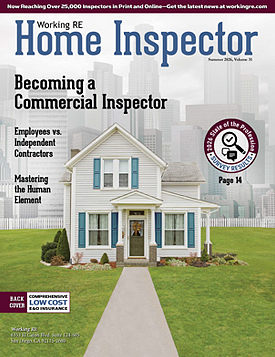
Becoming a Commercial Inspector
by Isaac Peck, Publisher
What started as a narrow specialty, mostly handled by engineers and a small group of dedicated commercial property specialists, has been quietly developing into something broader. An increasing number of home inspectors are branching out into the commercial realm, drawn by higher fees, repeat-client relationships, and a professional infrastructure that didn’t exist a decade ago.
While the work is more complex, the difference in fees is striking. A typical residential inspection runs $550. A commercial inspection can run $5,000. A large multi-property commercial inspection project can command $50,000 or more. Commercial work is less transactional and more relationship-driven than residential. A client who owns or manages multiple buildings doesn’t hire a new inspector every time. They hire one inspector, repeatedly. That dynamic rewards inspectors who build long-term client relationships, just like in the residential space.
The Certified Commercial Property Inspectors Association (CCPIA®), founded in 2018 by Nick Gromicko of InterNACHI®, has become the central organizing force behind this shift. What started as a way to build community and share education for commercial inspectors has grown into a nationwide network of more than 2,000 member firms. The association provides training, standards of practice, and a unified professional identity that gives clients something to look for and inspectors something to point to.
Working RE Home Inspector spoke with leaders at CCPIA® and with inspectors who have built full-time commercial practices to find out what this market actually looks like on the ground, what it takes to get in, and what to expect when you do.
Growing CCPIA® and Growing Demand
According to leaders at CCPIA®, commercial inspection demand is rising because the market is beginning to recognize the need. “Growth is driven by need,” said Maggie Aey, Executive Director at CCPIA®. She compared today’s commercial inspection landscape to the early days of home inspections, when the idea of hiring a professional inspector wasn’t yet a household norm. “Way back when, home inspections weren’t a household name. Today, everybody needs a home inspection. With commercial, we’re in that same phase, the market is recognizing the need.”
In other words, the commercial sector is experiencing the same awakening the residential sector went through decades ago. The demand for inspectors is, at least for now, rising faster than the supply. This is partly due to the sheer diversity of commercial clients. “Folks are buying multiple properties, there are maintenance related inspections, there’s a lot more opportunity,” Aey explained.
Unlike residential inspectors, who often rely on a steady flow of one-off homebuyers, commercial inspectors can build long-term relationships with clients who own or manage multiple buildings. “Don’t wait for one client to move,” Aey said. “One client might give you many different jobs.” She also noted that commercial inspections have traditionally been perceived as the domain of engineers, even though most commercial inspections don’t require engineering-level analysis. Instead, inspectors with a strong foundational understanding of building systems are often exactly what clients need.
Once a commercial client finds an inspector they trust, the relationship tends to stick. “If they work with a client once, that client will hire them again and again,” Aey said, pointing out that some inspectors specialize in churches, others in restaurants, warehouses, or office spaces. The key is to match local demand with inspector expertise. “In general, we expect commercial inspections will continue to grow as awareness rises and clients see the value in what they’re getting.”
Rob Claus, CCPIA®‘s Director of Education, adds another dimension to the demand story: the rise of small-business buyers who need due diligence without the cost or complexity of a full engineering assessment. “Single owners, owning single buildings—these people are small business owners,” he explained. “They don’t want to pay for the level of due diligence that larger engineering-type portfolio jobs would provide. They just want a knowledgeable building consultant who can give them a clear, actionable understanding of the property they’re about to buy. Or they might be about to sign a triple-net lease and want to understand the current condition of the building.”
Claus recalled that, years ago, when he first started exploring this work, he was careful not to call himself a home inspector to potential commercial clients. “We called ourselves building consultants or property inspectors,” he said. In a way, that’s what today’s commercial inspectors are stepping into: they are advisors who help clients make informed decisions about complex, high-value properties that they won’t be living in, and may not even be living close to.
While Claus has always had an interest in commercial inspections and was performing them before CCPIA® was founded, he says CCPIA® arrived at exactly the right moment, giving him, and the commercial inspection field, a structure, standards, and a clear professional identity.
“Did we have a great SOP to rely on before CCPIA®?” he asked rhetorically. “No. We just listened to the client, went out, and did what we could.” For decades, commercial inspections existed in a gray zone between engineering firms and generalist inspectors, with no unified standard of practice and no dedicated training pipeline. 2016 changed all that for Claus. Like many others, Claus found “the ComSOP, InterNACHI®‘s SOP for commercial property inspections.” “I used it as the complete cornerstone for building a commercial division of our company.” With a real standard to anchor the work, he built a sustainable commercial division in a matter of months, and it now supports multiple inspectors’ careers. When CCPIA® was founded soon after, he reached out.
CCPIA® anticipated a wide expansion in unmet need, and was correct. That unmet need is now driving the surge in demand. Commercial inspections are becoming the standard due-diligence tool for everyday business owners. With Claus helping CCPIA® provide training, standards, and a professional community, the industry has better odds of meeting that demand.
(story continues below)

(story continues)
One Inspector’s Full-Time Commercial Practice
Working RE Home Inspector reached out to Brad McLeese, a Northern Utah inspector who has built a full-time commercial practice, to hear how he made the transition. McLeese didn’t begin with any grand plan. Like many inspectors, he stumbled into the opportunities, in his case through a conversation with a client. His homebuyer client happened to work for an engineering firm and mentioned to McLeese that their firm performed commercial property condition assessments for buyers and lenders. The client asked whether McLeese might be interested in helping. Shortly after that, he was exposed to commercial property condition assessments offered by national engineering firms, primarily for lenders and underwriters.
His role at the time was as a field observer, working within the ASTM framework used by engineering firms. He inspected massive properties such as shopping centers of 200,000 to 300,000 square feet, taking plenty of photos, providing extensive documentation, and assisting in the completion of the reports (in Microsoft Word) for engineers to finalize. The reports showed cost opinions for repairs, replacements, and mechanical equipment and were, McLeese recalled, far more detailed than anything a home inspector typically encounters.
Soon, McLeese began to see a gap in the market. The reports he helped produce were for lenders, not for the “small businessperson, the main-street marketplace, business owners, CEOs expanding or buying buildings, or investors purchasing properties for leasebacks,” he said. Rather than 200-page engineering documents, those clients needed efficient reports that conveyed a practical understanding of the building they were about to occupy.
So McLeese began focusing on buildings under 50,000 square feet, properties where he could “provide more value, do it more economically, and offer a quicker turnaround.” Eventually, he transitioned into performing commercial inspections independently through his own firm. Today, he works full-time in commercial inspections (his firm still handles some residential work, but he told me his personal focus and passion is entirely commercial).
It was in that refocusing stage to smaller properties that McLeese discovered CCPIA®, quickly realizing that its SOP aligned far more closely with the kind of inspections he wanted to perform. As he adapted his reports for small-business clients, he found that his format “resembled more and more what CCPIA® was advocating.” Eventually, he made the transition “official” by rewriting his agreements, restructuring his reports, and even creating a separate website dedicated to commercial inspections (we’ll hear more about separate branding and compartmentalization of residential and commercial).
McLeese said he likes CCPIA®‘s training modules, fast-track courses, in-person sessions, and access to experienced inspectors like Claus. He called it “overwhelming value.” The membership fee, in his view, doesn’t come close to the worth of the resources and support.
Candid about his learning curve, McLeese told us he has underbid projects, found himself overwhelmed by unfamiliar systems, and learned through experience how different commercial buildings can be. Convenience stores, he said, often have underground storage tanks and complex distinctions between fixtures and permanently installed equipment. Industrial buildings introduced him to makeup-air systems he had never encountered before. But curiosity carried him through. “Over time, with curiosity and wanting to figure out how things worked, I got that experience little by little.”
McLeese emphasized that this wasn’t just about higher fees. “If you go into it just wanting to make more money, you probably won’t be successful,” he said. It really helps to be genuinely interested in how buildings work. “Sometimes I’ll spend way longer at a commercial building than I anticipated because I’m trying to figure out how the mechanical system works,” he explained.
CCPIA® as a Marketing Tool
The first thing you need to know about Todd Hoffmeyer, head of TC Property Inspections, is that he’s gotten most of his clients from the CCPIA® website.
Four years ago, Hoffmeyer began shifting from residential into commercial inspections, a move that has steadily reshaped his business. “Each year I do more and more commercial,” he said, noting that his residential side may eventually become passive income as commercial work continues to expand. Before entering the inspection field, he spent years as a journeyman electrician and tool and die maker. In 2013, when a labor dispute left him unexpectedly locked out of his job, he pivoted quickly: “Nobody thought we’d be out more than a couple weeks. I went and got some training for a home inspector and joined InterNACHI®.”
He discovered CCPIA® later, initially online, but the turning point came when he began attending their trainings. “About four years ago I started looking into that page and they just kept rolling after that,” he said. Since then, he has immersed himself in commercial training, starting with a three-day session in Bloomsburg, Pennsylvania, followed by a one-day field course in Chicago and another three-day session in Indiana, all led by Rob Claus. “They keep offering more and more training and I just can’t get enough of it,” Hoffmeyer told me. “The more we learn, the more our confidence increases.”
Today, 30–35 percent of his business is commercial, and “that number keeps growing.” His portfolio spans office buildings, warehouses, bowling alleys, restaurants, storage facilities, industrial sites, banks, wildlife centers, storefronts, bars, hibachi restaurants, multi-family complexes with over 100 units, churches, YWCA facilities, and large corporate buildings.
One difference that surprised Hoffmeyer was the relative lack of franticness in commercial inspections; they aren’t as rushed as home inspections. While residential deals are often squeezed into five- to seven-day deadlines, commercial clients allow more time for proposals, scheduling, and reporting. “The final reports aren’t as much of a time strain,” he explained.
Commercial clients are also often more knowledgeable and easier to communicate with, since they know they’re in a business relationship. Add the fact that one or two commercial inspections is as profitable as a week’s worth of residential, and you can see why commercial portfolios are attractive.
But perhaps most noteworthy is Hoffmeyer’s marketing strategy: “Join CCPIA®,” he said. In addition to the learning, most of his leads come from online visibility, chiefly CCPIA®‘s site, as well as some of his own, supplemented by light networking with commercial real estate agents. From there, momentum builds naturally. “Just online marketing. Word of mouth. Once you do one, it seems like they keep coming in.”
(story continues below)

(story continues)
Training + Insurance Protection
For many inspectors stepping into commercial work, the learning curve isn’t the only intimidating part. Insurance, from coverage and exclusions to how a policy interacts with an inspector’s actual scope of work, can be challenging.
Most inspector E&O policies still exclude many commercial properties, leaving many inspectors with restrictive coverage that forces them to decline jobs, operate without adequate protection, or guess whether their policy actually applies to the building they’re about to inspect. Northern Utah’s McLeese says his experience with such a limited policy highlighted just how limited some residential-focused policies can be when an inspector begins taking on larger commercial work. His carrier, he said, became “increasingly nervous” as his commercial volume grew. At renewal, they reminded him that their policy “isn’t really geared toward a $10 million building or an apartment complex,” and that it was fundamentally designed for residential homes. They only “begrudgingly” allowed light industrial or small commercial jobs and the rising percentage of commercial inspections “made them more and more nervous” year after year.
As CCPIA® Executive Director Maggie Aey explained, another challenge is that policyholders are often unaware of what exactly they’re being covered for. Aey has been with CCPIA® since day one, and she’s spoken with thousands of inspectors about their insurance needs. Historically, she told me, commercial inspections were simply “endorsed” on a policy, granted permission to perform commercial inspections without a clear explanation of what that endorsement actually covered. That lack of transparency left inspectors unsure of their limits, especially when it came to specialized areas like fire suppression and life safety systems. Many didn’t realize which components they were responsible for and which were outside their scope. “Inspectors have struggled to understand what parts they’re inspecting,” she noted, emphasizing that commercial inspectors are not meant to “surpass fire marshal inspections or anything like that.”
That’s where the ComSOP comes in. Claus describes CCPIA®‘s ComSOP as “a true SOP,” one that gives clients confidence because “they know the property was observed using this benchmark.” For inspectors new to commercial work, it defines exactly what they’re responsible for observing. That’s where their scope ends. The training framework already tells an inspector what they’re responsible for. The insurance question is whether the policy reflects that same clarity.
That’s the gap the CCPIA®-aligned policy from OREP Insurance is designed to close. Working directly with CCPIA® to understand where current inspection policies were coming up short, OREP built a policy around the association’s actual standards. Aey described it as “transparent and built around their training,” meaning inspectors are not only insured but “insured and backed by their training as well.” The result is coverage structured around what CCPIA® actually teaches, not a generic commercial endorsement tacked onto a residential policy. No square-footage limits. Clearly defined fire and life safety coverage. Inspectors know exactly where they stand.
Restaurants, for example, have always been a sticking point because they are at higher risk for fires. Inspectors weren’t sure whether they were covered to inspect them. Aey said that the OREP policy’s new clarity around restaurant coverage is “very big,” because inspectors can finally know with confidence whether they’re protected. “Truly knowing what you’re covered for,” she explained, and then being trained to stay within that coverage, “brings everything full circle.”
The OREP policy, exclusive to CCPIA® members, covers inspection of properties over 100,000 sq. ft. (a common restriction on regular inspection policies) and extends coverage to restaurants, warehouses, hotels, healthcare facilities, schools, churches, shopping centers, mixed-use buildings, and more. The only remaining restriction applies to heavy-industrial sites such as power plants, refineries, petrochemical facilities, and mining operations.
Inspectors don’t need to be fully committed to commercial work to benefit. OREP’s base Professional Inspector Policy already covers apartments, condominiums, office buildings, and non-restaurant retail properties under 100,000 square feet at no additional premium, giving newer commercial inspectors immediate protection for many of the most common building types. As commercial volume grows, inspectors can step up to the full CCPIA® endorsement. The requirements are four: maintain active CCPIA® membership, follow the CCPIA® Standards of Practice, use a CCPIA®-prepared or OREP-approved commercial inspection agreement, and avoid heavy-industrial inspections. Inspectors can learn more and get a quote here.
Getting Started in Commercial Inspections
For inspectors considering whether to step into commercial work, Rob Claus offered a simple piece of advice: “Run, don’t walk.” Like Aey, he told me he sees commercial inspections today the way home inspections looked six decades ago. “Sixty years ago, nobody knew about home inspections,” he explained. “Here we are now, and you hardly purchase a property without one. There’s something to be said about being a first mover in a new industry,” Claus argued, because the inspector who builds a commercial practice now effectively “calls dibs” on their market. Anyone who enters later “has to do what I did or be better than what I did, otherwise they’re lesser.”
Another lesson emerging from inspectors already working in this space is the importance of branding. The commercial side of your business will benefit, we’ve been told, from being distinct from the residential side. McLeese was unequivocal on this. “It’s critical,” he said. In his experience, the home inspection label simply doesn’t translate into the commercial world. Residential inspectors are closely tied to real estate agents, he explained, and that association carries a connotation that commercial professionals don’t trust. “The name has a connotation to most commercial real estate professionals that it’s really more part of the home, not a commercial entity.” Even when commercial brokers liked working with him, they hesitated to refer him to high-level clients because the branding made them uneasy. As he puts it, recommending a home inspection company to a CEO evaluating a $10, $15, or $20 million property “would make them look bad.” Creating a distinct brand tells commercial clients that you understand their world, their stakes, and their expectations.
The inspectors already working in this space are consistent on one point: the time to move is now. Commercial demand is growing, the supply of trained inspectors hasn’t caught up, and the inspectors who build their practice and reputation today will be the hardest to displace once the market matures. Training, branding, and insurance coverage are all more accessible than they’ve ever been. To your success!
About the Author
Isaac Peck is the Publisher of Working RE magazine and the Senior Broker and President of OREP.org, a leading provider of E&O insurance for savvy professionals in 50 states and DC. Over 14,000 professionals trust OREP for their E&O and liability insurance. Isaac received his master’s degree in accounting at San Diego State University. Reach Isaac at isaac@orep.org or (888) 347-5273. CA License #4116465.
Published by OREP Insurance Services, LLC. Calif. License #0K99465