

 |
> E&O/GL Insurance for Home Inspectors |
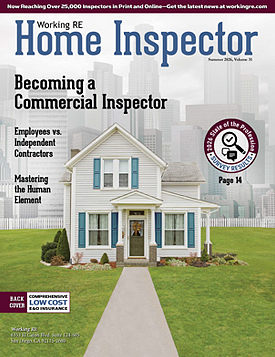
Understanding Employment Classification: What Home Inspectors Need to Know
by Isaac Peck, Publisher
A federal court ruled earlier this year that Seek Now, Inc., a national property-data firm, acted coercively when it attempted to push its field inspectors into individual arbitration while those same inspectors were actively challenging their classification as independent contractors. The court froze the new agreements before they could take effect. The case, McPherson v. Seek Now, Inc., didn’t resolve the underlying classification question—but it sent a clear signal about how courts view companies that try to maneuver around worker protections while litigation is pending.
For home inspectors, the case is a useful entry point into a question that affects every inspection business that hires help: when does a working relationship cross the line from independent contractor to employee, and what happens when you get that wrong?
The answer matters practically. Employment classification determines who pays taxes, who carries insurance, who controls the workday, and who bears liability when something goes wrong on a job. For inspection firms, a misclassification finding can mean back taxes, penalties, and damages. For inspectors working as 1099 contractors, it can mean discovering too late that the protections they assumed they had don’t actually apply to them.
Employees vs. Independent Contractors: The Basics
At its core, employment classification law asks a simple question: who controls the work? The way courts answer that question varies depending on the state, the agency doing the investigating, and the specific facts of the job.
An employee is someone whose work is directed by the employer. The employer decides how the work is done, when it’s done, and often with what tools. Employees are trained by the business, integrated into its operations, and economically dependent on it.
An independent contractor, by contrast, is in business for themselves. They control their own schedule, bring their own tools, set their own methods, and can take on multiple clients. They are responsible for their own taxes and insurance. They declare their own profits and losses.
On paper, the distinction is clean. In practice, it gets complicated fast. A successful inspector needs more help during busy seasons and wants the flexibility of contractors but the consistency of employees. A new inspector wants to pick up work without a long-term commitment. The relationships that result are often more informal than the law allows, and they tend to evolve faster than the paperwork that governs them.
A contractor who starts out taking occasional overflow jobs becomes the go-to person for every inspection on the east side of town. An assistant who was supposed to help with photos ends up following your scripts, using your software, and representing your brand. The law doesn’t sort those relationships out gently. It does so at the worst possible moment, during a dispute or after an injury, and in ways that can be disastrous for your business.
(story continues below)

(story continues)
The Tests
Courts don’t determine employment status by looking at job titles or contract language. You can call someone an independent contractor, but if the working relationship functions like employment, the law will usually treat it that way. Three major tests dominate.
The common-law control test, used by the IRS and many states, focuses on how much direction an employer exercises over both the outcome of the work and the manner in which it is performed. In home inspection, that control includes things like dictating inspection procedures, requiring specific hours or routes, mandating company-branded tools or software, reviewing every report before it goes out, or limiting an inspector’s ability to work for others. If you dictate the “how” rather than simply the “what,” courts tend to view your worker as an employee.
The economic realities test, used by the Department of Labor for federal wage law, looks at whether the worker is genuinely running an independent business. Courts consider whether the inspector has their own business entity, markets to multiple clients, invests in their own tools and insurance, and can declare profits and losses based on their own decisions. Heavy dependence on a single client for income is a strong indicator of employee status.
The ABC test, used in states like California, Massachusetts, and New Jersey, is the strictest of the three. It presumes a worker is an employee unless the company proves all three elements: the worker is free from control, the work performed is outside the company’s usual course of business, and the worker operates an independent business doing that same kind of work. For home inspection firms, the second element is often the stumbling block. If your business is home inspections and you hire someone to conduct home inspections, that person will likely be considered an employee in ABC states. Check with your state labor department to identify which test applies to your situation.
Understanding these tests has practical consequences. If you hire a new inspector, train them, set their schedule, and review every report they write, that’s going to look like employment to a court, even if the contract says otherwise. If a firm requires inspectors to wear branded shirts, use company software, and follow a strict inspection template, that’s virtually certain to be considered employment. Restricting outside work is also a strong indicator: if you hire part-timers during busy seasons but prohibit them from working for competitors, be prepared to classify them as employees. On the other hand, if a seasoned inspector with their own LLC takes overflow work from a firm, uses their own tools, and sets their own hours, that leans toward independent contractor status, though ABC rules may still apply in your state.
The Courts
Courts consistently look at actual behavior rather than job titles or contract provisions. They also don’t look kindly on employers who behave evasively around the classification question, and McPherson is a direct illustration of what that looks like in the inspection industry.
(story continues below)

(story continues)
Seek Now is a national property-data and inspection company that relies on a large network of field inspectors to gather photos, measurements, and on-site assessments for insurers and real estate clients. Although the company labeled these workers as contractors, the plaintiffs argued their day-to-day reality looked far more controlled: jobs were assigned through Seek Now’s platform, with strict turnaround times, required reporting formats, and work that formed the core of the company’s business.
While that misclassification claim was pending, Seek Now sent inspectors a new Master Services Agreement and arbitration clause. The message was direct: sign the new documents or stop receiving assignments. The agreements would have forced disputes into individual arbitration and effectively blocked inspectors from joining the collective action. The court stepped in quickly, found the rollout coercive and likely to chill workers’ Fair Labor Standards Act (FLSA) rights, froze the new agreements, barred Seek Now from enforcing them, and ordered corrective notice. The ruling didn’t decide whether inspectors are employees, but it made clear that companies cannot use mid-litigation contract changes to protect a contractor model already under legal scrutiny.
The broader cases, Dynamex Operations West, Inc. v. Superior Court and SuperShuttle DFW, Inc. v. NLRB, operate at the level of classification doctrine. Dynamex is the foundation of the ABC test, placing a heavy burden on companies to prove contractor status. SuperShuttle leans the other direction, emphasizing entrepreneurial opportunity as a sign of independence. McPherson is different. It shows that an employer can run into serious legal trouble before any court even reaches those classification tests, simply by not acting in good faith. Courts are increasingly willing to enforce not just the outcome of a classification model, but the fairness of the model itself.
How Home Inspectors Acting as Employers or Contractors Can Reduce Risk
If you want a contractor relationship, you have to build it intentionally and maintain it consistently. That means giving real autonomy, allowing inspectors to work for others, avoiding control over the “how,” and resisting the temptation to tighten the reins when business gets busy. If you want an employee relationship, own the responsibilities that come with it rather than trying to retrofit independence onto a structure that doesn’t support it.
Start by deciding honestly what you want: control or flexibility. If you want to control how inspections are done, hire employees. If you want flexibility, contractors may work, but only if you genuinely give up control. Put the relationship in writing. A contract won’t override the law, but it clarifies expectations and documents intent. For contractors, acknowledge their freedom to work for others, their responsibility for their own tools and insurance, and their control over their own schedule.
If you choose the contractor model, resist the urge to dictate every detail. Provide outcomes, not instructions. Keep records of how inspectors are paid, how they schedule work, and what tools they use. Good documentation matters if a dispute arises. And consult a local employment attorney before you build out a contractor structure. Employment law varies significantly by state, and a short consultation is far cheaper than a misclassification finding.
For inspectors working as 1099 contractors, the protective steps run in the other direction. Establish a formal written contract that includes indemnification clauses. Structure your business properly, most likely as an LLC, to separate personal from business liability. Maintain strict independence in how your work is performed and make that independence visible, to your client and on paper.
Insurance coverage deserves the same attention as the contract itself. OREP’s home inspector E&O policy includes independent contractors within the definition of “Insured,” meaning if you work for a firm that carries OREP coverage, you may be covered under their policy. But there is a critical condition: your name must appear at the top of the pre-inspection agreement alongside the name of the hiring business for coverage to apply. A contractor who shows up on a job where only the firm’s name is on the agreement has no coverage under that policy, regardless of how the work goes. Before you take an assignment, confirm that your name is on the paperwork. That one step is the difference between being covered and being exposed. Independent inspectors who want coverage that follows them regardless of who they’re working for can explore their own OREP policy at OREP.org/inspectors.
This Is Really About Relationships
At the center of every classification dispute—every test, every factor, every lawsuit—is a relationship between two parties trying to get work done. Employment classification is an imperfect but necessary part of making those relationships work. The way you structure your working relationships determines who carries liability, who controls the work, and how much legal exposure you inherit when something goes wrong.
Courts have made one thing clear: they care far less about the labels you choose than about the reality of the relationships you create. If you want contractors, build a model that actually gives people independence. If you want employees, own the responsibilities that come with that choice. Treat classification as a structural decision, not a paperwork problem, and you’ll be in a much better position if a dispute ever lands on your doorstep.
Stay safe out there!
About the Author
Isaac Peck is the Publisher of Working RE magazine and the Senior Broker and President of OREP.org, a leading provider of E&O insurance for savvy professionals in 50 states and DC. Over 14,000 professionals trust OREP for their E&O and liability insurance. Isaac received his master’s degree in accounting at San Diego State University. Reach Isaac at isaac@orep.org or (888) 347-5273. CA License #4116465.
Published by OREP Insurance Services, LLC. Calif. License #0K99465