


 |
> Appraiser Coach > AMC Resource Guide > OREP E&O |
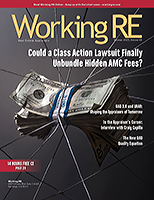
In the Appraiser’s Corner: Interview with Craig Capilla
by Isaac Peck, Publisher
Real estate appraisers have faced myriad legal and regulatory challenges and risks over the last five years.
From the roughly 2,000 loan buybacks and state board complaints (per year) initiated by Fannie Mae and Freddie Mac to the nearly 300 discrimination complaints filed with HUD and the numerous discrimination-related lawsuits filed against appraisers in court (including one by the Department of Justice), appraisers have been feeling the heat.
With a new Administration in the White House and political shockwaves running through the federal government, where do appraisers stand today? One person uniquely qualified to answer this is Craig Capilla, Partner at Franklin, Greenswag, Channon & Capilla, LLC in Northern Illinois. While a handful of attorneys specialize in appraisal litigation and regulatory issues, Capilla has been on the front lines of appraiser defense for the last decade.
Working RE sat down with Capilla to hear more about his journey, his experience defending appraisers over the last decade, and what he sees coming next for appraisers in the near future.
Working RE: Tell us about your professional background. How did you get involved in working with real estate professionals and appraisers specifically?
Capilla: I moved to Chicago, Illinois to attend law school and my first real legal job upon graduation was working for a transactional law firm that was doing a lot of transactional work on residential and mixed-use commercial properties. This gave me some exposure to real estate brokers and appraisers from a distance. The transactional work was good until the economy started to take a turn in 2007 and 2008. I remember we only had three closings the entire month of October 2007. I knew I was going to have to pivot in my career and started exploring. I even interviewed at a divorce law firm, but I decided I couldn’t do that every day.
By January 2008, I got an opportunity to interview with the state licensing agency in Illinois. I started in March 2008, on the Thursday before Bear Stearns collapsed. For the next four and a half years I was the licensing board prosecutor. I was the only one in the department for a period of time. The primary professions we oversaw were real estate brokers, appraisers, home inspectors, and a handful of others. I was actively involved in prosecuting every license board complaint the agency pursued and got a very in-depth look at how a large regulatory agency functions—how it evaluates and prosecutes cases.
Four and a half years later I decided I wanted to move into private practice and Charlie Franklin, of the Franklin Law Group, was expanding his firm so I reached out to him. Franklin had been defending appraisers against me for years when I worked for the state and was one of only a few attorneys that was focused on defending licensees. He really knew the material, he knew USPAP, and did a really good job defending appraisers and the other professionals he would represent. So I ended up joining his firm and I’ve been focused on the defense side of litigation and license complaints ever since. Now 12 and a half years later, here I am, doing the same thing. We’ve built on the practice and expanded our footprint geographically.
Working RE: Fannie Mae and Freddie Mac (the GSEs) are reportedly filing around 1,000 complaints (each) against appraisers with their state regulatory board. Each of these complaints is preceded by a loan buyback forced on the lender. So that’s at least 2,000 loan buybacks pushed through every year because of alleged appraisal deficiencies. Have you seen an increase in buyback related litigation against appraisers?
Capilla: To some extent. We aren’t necessarily seeing all the buyback demands land in the appraiser’s lap. Some are handled at the appraisal management company or lender level. Not every buyback demand results in a claim against an appraiser. All buybacks that are pushed through do result in a “tip” that is submitted by the GSEs to the state regulators. Where it goes from there really depends on the state. Some states don’t treat them as a complaint and don’t investigate. Other states treat it as a complaint and look into every single one of them. This adds to inconsistency and confusion for appraisers. Whether the state investigates or not, or whether the complaint is dismissed or not, a GSE tip sent to the board is still an indication that a loan buyback was pushed through and a claim can definitely result from that (even if it’s a rarer occurrence). Sometimes we see a claim develop a year or two after the buyback happens.
Working RE: How often do you work with appraisers who get coverage denied because they didn’t notify their insurance carrier of a board complaint or a “potential” claim?
Capilla: Thankfully, I see this less than I used to. Maybe we’re doing a better job of educating and informing appraisers about the necessity of reporting things to the carrier. But I still hear from appraisers multiple times per month asking whether they should report a particular issue to their insurance carrier. I always advise to err on the side of caution. Even if it is the most minor thing, turn it in to the carrier as a notice of a potential claim. If nothing develops and you don’t need coverage (i.e. it doesn’t turn into a claim), you can let the carrier know that. In our own practice, on my attorney’s E&O policy, we turn in everything we can think of as a potential claim. They can close the file tomorrow if they want, as long as we’ve got a written acknowledgement that I told them about it. That sort of mentality is lacking in the appraisal space. The big question is: Will this impact my premium? Sometimes yes, sometimes no. But any premium impact is a lot smaller than not having any coverage and having your claim denied. Failing to notify your insurance carrier about a board or licensing investigation, or about a potential claim, absolutely jeopardizes your coverage. Don’t take that risk.
(story continues below)

(story continues)
Working RE: There’s been a lot of buzz about discrimination complaints filed with the U.S. Department of Housing and Urban Development (HUD). Our latest data indicates that just under 300 complaints have been filed in the last five years. What are you seeing on that front?
Capilla: I’m not seeing any material changes, yet. We have heard from multiple sources that case closure notifications were starting to be sent out on some of these cases. I have a bunch of cases with HUD and I haven’t received any dismissals on the active files that I have. As far as action goes, I’m not getting contact from any of the investigators either. Before the transition to the new administration, the only notification I got was they were assigning it to a new investigator. There’s been no substantive changes for the last few years, and I’ve got several cases that have been in limbo for years. It’s still all quiet at the moment. I’ve most recently been notified that cases are being reassigned to the HUD investigators in their office of systemic investigations but I do not know whether that applies to all existing cases or whether that also might be a prelude to some substantive movement on these cases, one way or another.
Working RE: Relman Colfax, the law firm representing the plaintiffs in the Baltimore appraisal discrimination case, has reportedly billed over $3 million on the case. The Trump Administration’s mandates ending Diversity, Equity and Inclusion (DEI) will impact funding for non-profits like the National Fair Housing Alliance (NFHA). How will this affect discrimination complaints and lawsuits against appraisers?
Capilla: Most everyone is in a wait-and-see posture. The expectation is that the efforts to both reduce headcount and expenditures at HUD and cutting the funding to external non-profits is going to have an impact on appraisers. The immediate concern is that if funding is still out there and available, if the HUD cases get sidelined, there’s a possibility those cases will get removed to federal court or wind up in litigation funded by non-profits like NFHA. Liability events are going to start stacking up in that way.
The NFHA and other DEI-focused non-profits like the National Urban League have all seen their federal funding either cut or severely threatened. Even still, federal funds only make up 25 to 30 percent of NFHA funding, so it’s not as if these organizations are going to be completely defunded. The actions of the current administration and the funding cuts might also embolden donors. I wouldn’t say we’re out of the woods yet. Just because we haven’t seen the litigation yet doesn’t mean it’s not coming.
The cutting of federal funding, however, will likely force some hard choices at these non-profits. The ability to fund these private lawsuits is a legitimate concern. Even though federal funding is not all of their funding, it still requires some significant recalibration when you’re looking at an organization losing a material percentage of funding. I think instead of sounding the all clear for appraisers, this is more about reassessing where everyone stands right now instead of just declaring victory. That may be where we are though, we’ll have to wait and see. So far, I would say that non-profits haven’t seen much in the way of return on their legal expenditure.
Working RE: What about GSE policy? Do you think the movement to ban certain words in appraisals will be rolled back? And the new ROV rules?
Capilla: We don’t expect the GSEs to walk back their Do Not Use (DNU) word list or move back towards subjective language. It was notable that FHFA rolled back the Reconsideration of Value (ROV) procedures. The ROV rules had been worked on for years with several different agencies and tons of input from many organizations, but they were immediately rescinded as though they had never occurred. The procedures had been in place for five or six months. It’s also important to note that it wasn’t a strategic rollback where they just tried to remove the bias and discrimination components of the rules. The approach was more that because somewhere in the procedures it references bias and discrimination, they just removed the whole thing. That casts uncertainty at all levels for the rest of the GSE’s requirements. It creates uncertainty for appraisers and for state regulators. Regulators were gearing up for a wave of referrals coming from AMCs and lenders because ROVs were going to require mandatory reporting. That’s all gone away now. Without a singular process for borrower-initiated ROVs, there’s nothing uniform and consistent for stakeholders to work off of.
(story continues below)

(story continues)
Working RE: What are some of the latest threats and exposures you see facing appraisers today?
Capilla: First, the new UAD 3.6 format is going to create a lot of heartburn for appraisers. Particularly those that aren’t prepared to move onto that format and get comfortable using it. In a way, we’re seeing a forced adaption to current technology. So appraisers that are behind the curve on technology in their own day-to-day practice are going to struggle.
Second, even if we’re removing bias and discrimination concerns from the state regulatory environment, there is still a keen sense that we’re going to be seeing more substantive complaints about appraisal and its reporting. There is a renewed focus on appraisers showing support for adjustments and conclusions of value.
Third, in the era of hybrid and bifurcated assignments, for full appraisals and full field inspections, we’ve heard for a while that some appraisers in practice have been signing as the appraiser for the assignment but were not themselves performing the actual subject property inspection. Various state regulators are keying into that problem. Federal investigators and federal enforcement are also possible. The DOJ has begun investigating— particularly when looking at federally backed loans like FHA/HUD and VA loans. It looks like state and federal prosecutors will be taking active steps to prosecute those matters.
Working RE: Do you see the new UAD 3.6 and the GSE’s moves towards more hybrid valuations changing the liability environment for appraisers in the next few years?
Capilla: In a perfect world, the new UAD 3.6 format should help reduce liability because of the way it is designed. It will be more work for appraisers on the front-end because it requires appraisers to provide more details when prompted. In theory, the additional detail and support required within the UAD 3.6 should help reduce revision requests, reconsiderations of value, and reduce errors in the final reporting itself.
The use of hybrid appraisals and property data collectors (PDC) will also affect liability. Having someone, or no one at all, inspect the property, is anticipated to mitigate the risk to appraisers around bias and discrimination. Many of the appraisal discrimination related claims allege that the appraiser “identified and determined the race of the borrower” and then started making biased judgements. So if the appraiser never runs across the borrower, or an individual planted there to act as the borrower, presumably, the appraiser would not have the information available to make biased decisions. This should ultimately serve to dial back the discrimination-related liability somewhat.
How hybrids or PDCs will affect appraiser liability in other ways is an open question. If the appraiser is not measuring the subject, they can’t also mis-measure the subject. But is there anybody else to absorb that liability? Right now there is no liability coverage for whoever might be out in the field obtaining that information. The appraiser is required to certify they have all the information they need to perform the assignment competently. Of course, reliance on third-party information is not a new thing either, it’s always been a feature of the appraiser’s role. But there are new ways these PDCs could be wrong. I don’t see the liability environment changing much at all. If it does, it should reduce the liability that appraisers are facing.
Working RE: What do you think are the key issues that appraisers should focus on to protect themselves and their businesses today and going forward?
Capilla: The first main issue is that there is no room left for an appraiser to shun technology and tools. Appraisers must be competent in the tools, approaches and methodology that their peers are using. Appraisers that have been resisting change for years because “this” is the way you’ve always done it, that is the pathway to disaster. It’s a recipe to be either out of business or in trouble and on your way out of business. That means that the time to become modernized and competent has long passed. There’s no hiding from it anymore.
The second issue is that there will be a heightened focus on reporting and USPAP. This is more important than ever—appraisers are not just filling in boxes. They really need to go through the process of explaining to their reader what they did and why they did it. The UAD 3.6 format is going to drag everyone in that direction anyway. But for non-lender work and for lenders that aren’t selling their loans and instead hold on to their paper, those appraisals may not go to the GSEs and may not require the UAD 3.6 format. The expectation is that appraisers are still going to be reporting their conclusions and opinions at a heightened level. Thinking you can avoid that responsibility just by not working for the GSEs won’t work. Whether you like it or not, without UAD 3.6 you may not have to jump through all the hoops, but this is a rising tide that lifts all boats. The ones that don’t float up are going to get swamped.
This also extends to the workfile—to truly document your processes for your reader. The support for your adjustments, opinions, and conclusions needs to be in your workfile. Amongst appraisers, modernization is a bad word. What appraisers are hearing is: “This is how tools and technology are going to come in and replace the appraiser.” But modernization is going to force the tightening of business practices that are long overdue to be tightened up. In fact, because of the tools and tech, keeping a tight workfile has never been easier. Failing to do that is more inexcusable than it has ever been. Regulators, lenders, and enforcement are not going to be cutting as much slack for that anymore. Appraisers can use tools and tech to make their work more defensible, be more efficient, and build their workfile.
About the Author
Isaac Peck is the Publisher of Working RE magazine and the President of OREP Insurance, a leading provider of E&O insurance for real estate professionals. OREP serves over 10,000 appraisers with comprehensive E&O coverage, competitive rates, and 14 hours of CE at no charge for OREP Members (CE not approved in IL, MN, GA). Visit OREP.org to learn more. Reach Isaac at isaac@orep.org or (888) 347-5273. CA License #4116465.
OREP Insurance Services, LLC. Calif. License #0K99465
by steve
Working RE: What do you think are the key issues that appraisers should focus on to protect themselves and their businesses today and going forward?
Capilla: The first main issue is that there is no room left for an appraiser to shun technology and tools. Appraisers must be competent in the tools, approaches and methodology that their peers are using…..
-I will add , don’t skimp on insurance..