

 | > E&O/GL Insurance for Home Inspectors Competitive Rates, Broad Coverage, Free Risk Management, online inspection support for tough questions, discounts on education and more… Professional Coverage, Competitive Pricing Shop OREP today! |
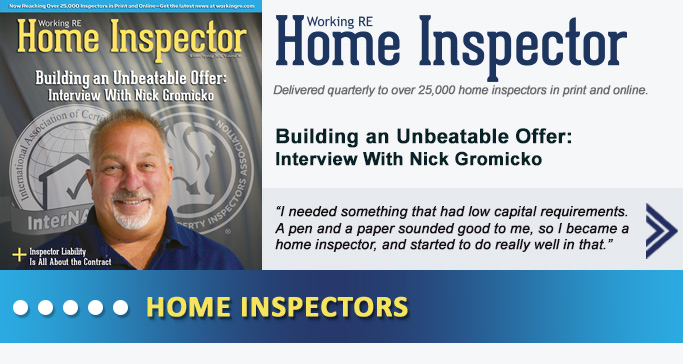
Building an Unbeatable Offer: Interview With Nick Gromicko
by Isaac Peck, Publisher
Most home inspectors are already members of the International Association of Certified Home Inspectors (InterNACHI), but few know the story of the man who founded and built it into the most dominant association for home inspectors across the globe: Nick Gromicko.
For home inspectors, his story is not just a personality profile; it’s a case study in how to build an unbeatable offer in your own market. If there is one through-line to Gromicko’s career, it is this: build an offer so strong that saying “yes” becomes a no-brainer.
InterNACHI is arguably the most powerful example in the home inspection profession of what happens when someone commits to that idea with relentless focus.
When I asked Gromicko what he fears most, he didn’t blink. “The fear that I’ve run out of planets. No more worlds left to conquer.”
It wasn’t a joke. In InterNACHI, Gromicko has built an association that is by far the largest, most dominant home inspector association in the United States, and around the globe.
InterNACHI’s reach in the home inspection profession is profound. It has influenced the regulatory structure of inspectors across the United States, exported its standards to dozens of countries, trained tens of thousands of home inspectors, and provided a staggering array of tools—technical, legal, business, and marketing—to support home inspectors and strengthen their businesses.
Starting in the early 1990s, InterNACHI has steadily grown from zero to over 30,000 home inspector members. Today,the vast majority of home inspectors who enter the profession join InterNACHI and stay members for the life of their careers.
The reason is simple: InterNACHI delivers an incredible amount of value to home inspectors. The list of benefits its members enjoy is nearly inexhaustible. “You’d have to be braindead to be a home inspector and not be a member of InterNACHI,” Gromicko remarks. “You’d have to be dumb as a brick.”
InterNACHI is to home inspector associations what Kleenex is to tissues—the category leader by sheer force of presence. In other words, InterNACHI is what it looks like when someone builds an offer so strong that it becomes the default choice. That’s exactly the kind of positioning every inspector should be aiming for in their local market.
So who exactly is Nick Gromicko? And how did he build Inter-NACHI into the powerhouse that it is today?
What follows is the story of the man behind the movement.
Who is Nick Gromicko?
I have a vivid memory of Gromicko from the 2023 InterNACHI conference in Atlantic City, New Jersey. InterNACHI’s CEO, Chris Morrell, had just wrapped up a 30-minute presentation detailing InterNACHI’s enormous accomplishments: hundreds of courses, 30,000+ members, Department of Education approval, dozens of certifications, and an ever-expanding list of member benefits.
At the end of Morrell’s presentation, Gromicko grabbed the mic. “What can I say about all that? What can I say?” he said, pausing for effect.
“Well … it’s a good start.”
That kind of ambition is part of what defines Gromicko—never satisfied, always building, always pushing for more. He’s not just growing an organization; he’s constantly asking how to make InterNACHI’s offer to inspectors so good it feels irrational to say no. The man has an unmatched ambition and an equally unmatched bravado.
Gromicko is the founder of InterNACHI, his flagship project, but he also launched the International Association of Certified Indoor Air Consultants (IAC2), serves as Executive Director of the Master Inspector Certification Board, is Executive Director of the Contractors Association, and authored the International Standards of Practice for Inspecting Commercial Properties used in roughly 60 countries.
He also curates the Inspection Museum, with exhibits like the first infrared camera used on an inspection in 1972 and the first battery-operated flashlight from 1898. And he serves as Director of Education and Training for the Certified Commercial Property Inspectors Association—a project that reflects his instinct to expand into new verticals long before others see the opportunity.
Then there’s Gromicko’s nonprofit and scholarship work. He founded the 501(c)(3) Cozy Coats for Kids and is the primary funder and sole administrator of the InterNACHI Scholarship Fund. He has personally donated over $1,000,000 to charity.
And when he’s not doing any of this, he’s the chief operating officer of his wife’s cosmetics firm, manages an organic farm, and works as a general contractor specializing in high-end outbuildings and heavy equipment projects. Not bad for a high school dropout.
“I’ve been able to change all the legislation I wanted, the way I wanted it, almost everywhere,” Gromicko says. “I sued the governor of Kentucky around 10 years ago for trying to make inspectors buy, I think it was a million-dollar insurance policy to do a radon test. So I sued the governor’s office and after that bill, they reversed it. You know, I called first and asked him to change it and they didn’t change it. So what do you want me to do?”
But as much as he’s surrounded himself with community and service, his bar for success is high even in his closest circles. “My wife has four degrees, two international business degrees, a marketing degree and an MBA. She writes and reads six languages and speaks a seventh. I barely speak English and have no high school diploma.” Aiming up is just what Gromicko does.
He told me he thinks about a well-known interview with Tiger Woods when the golfer first began to attract attention, in which Woods said “second place sucks, and third place is worse.” “I would’ve said the same thing with a straight face,” he told me. “I’m not interested in being number two at anything in life. What’s the purpose? Number two is worse than not playing at all.”
That unapologetic determination and confidence is a reminder that professions are often led by personalities. Gromicko has had the confidence to found and lead a trade organization for home inspectors in part because he has absolute confidence in his own skills as a businessman as well as a marketer. “Let’s say you blindfolded me, put me on a plane, gave me a parachute, and dropped me somewhere. I’d pull the cord and land in that town, and in thirty days, I’ll have all the home inspection business I want. I’ll just take everything away, and you could have 1,000 inspectors in that town, and 994 of them are not going to make it. I would take all their work from them.”
(story continues below)

(story continues)
Early Days of InterNACHI
In the late 1980s, the Gromicko brothers—Nick and Ben—were building houses. Ben was a bank inspector, and in the title of “inspector” Nick saw potential. Gromicko was working as a real estate agent at the time. Familiar with both the insides of homebuilding and the dynamics of the housing market, he decided he wanted to be a home inspector.
“I was looking for a business that was related to contracting,” says Gromicko. “I’d been a contractor since I was 12,” referring to the wide array of jobs that his young entrepreneurial mind had helped him create. “I needed something that had low-capital requirements. A pen and a paper sounded good to me, so I became a home inspector, and started to do really well in that.”
Gromicko recalls that he quickly realized that home inspectors didn’t have a trade association—at least not one that delivered real, tangible value to its members. That realization turned out to be timely. The housing market was getting more complicated, and inspectors were often left to navigate liability risks, unclear standards, and a lack of professional support on their own. There was no central body to advocate for them or offer consistent training, Gromicko argues. Gromicko saw that a trade association could fill that gap, giving inspectors both credibility and connection, a shared identity and the tools to build sustainable careers. “So we built that,” Gromicko says.
InterNACHI’s birth year was 1990, and its goal was to be a nonprofit that offered rigorous, accessible training while reinforcing inspector autonomy and long-term business success. In its earliest days, “we had to use snail mail, no internet,” Gromicko remembers. In Valley Forge, Pennsylvania, the group began with restaurant meetings. “Five guys came, then 10 guys. We opened our first Chapter in New York, and we drove to those meetings.”
Much of the organization’s initial growth came from word of mouth and online forums, where inspectors shared resources and helped shape the curriculum. That collaborative, connection-based approach would continue to define InterNACHI’s development, as the team focused on building practical, low-cost training that could be accessed remotely, a novel approach at the time.
Once internet technology increased in functionality, the group started online forums, then put videos on YouTube, and soon created “NACHI TV,” with streaming video. Their first online exam had three test-takers. Eventually there would be millions of posts on their forum and thousands taking the tests.
In the early 2000s, InterNACHI launched a comprehensive online platform that made certification and continuing education available to inspectors across North America and beyond, removing geographic and financial barriers to entry. The Certified Professional Inspector (CPI) designation became a cornerstone of the organization’s credibility, requiring members to pass exams, submit inspection reports for review, and commit to a strict code of ethics and standards of practice.
As the industry evolved, InterNACHI expanded its offerings to include legal templates, marketing tools, business development resources, and peer-to-peer support systems. By the 2010s, membership had surged into the tens of thousands, and the organization began hosting live training events and building physical facilities to complement its online reach.
For home inspectors, the lesson in these early years is clear: InterNACHI grew by identifying gaps in education, standards, business tools, community and filling them before anyone else did. InterNACHI didn’t just create some resources and then call it a day either—they continually add to the benefits their members enjoy—overdelivering on value on a daily basis.
How InterNACHI Dominated
I asked Gromicko about the keys to the success of InterNACHI. “There’s no competition,” he answered. “Imagine if you were on a racetrack and you had to run a race, and you [didn’t] have anybody racing against you.”
Underneath the bravado, Gromicko has a philosophy of overdelivering for his target market. Or in business terms, building an unbeatable offer. For example, InterNACHI hasn’t just developed a couple of courses for home inspectors. They’ve developed over 400 courses.
From coursework, to certifications like InterNACHI’s Certified Master Inspector® certification, to websites, logo design, and inspection contracts, InterNACHI is continuously developing tools and benefits that help its members grow and succeed. Every new tool—whether technical, marketing, or business-related— adds one more layer to the offer, making membership increasingly difficult to replace or compete with.
On the topic of education, Gromicko is especially proud of the fact that InterNACHI is an accredited university. “I get lucky a lot. At the time I was fighting for InterNACHI to become a university, there was a wave in this country where people on late-night talk shows were making fun of people with worthless degrees. While that’s going on, providing political pressure on one side, we’ve developed 400 practical courses in the trades. So, make us a university!” Gromicko says. That boldness earned InterNACHI a coveted “.edu” domain and an accreditation as a university by the United States Department of Education.
In this effort, Gromicko’s InterNACHI team was guided by a vision: “I wanted us to get to the point of inspectors being like engineers or architects,” Gromicko said. “I wanted home inspectors to be at that level. An engineer has a degree from a university. When an architect takes courses, they take university courses. So that’s why we had to become a University. We could bestow bachelor’s degrees if we wanted to. We’ll be able to do associates’ degrees in Home Inspection. Our courses transfer into University classes.”
In addition to its extensive coursework, InterNACHI’s forums are 20,000 members strong and serve as a vast, searchable archive of inspection knowledge, with thousands of threads covering technical, business, legal, and regulatory issues. From tool recommendations to report-writing tips and unusual defects, the forums are active daily. They are a living extension of the unbeatable offer—immediate support, shared expertise, and a community inspectors can rely on.
Gromicko says he is always thinking about what home inspectors need next and then having InterNACHI work to deliver it to them. “It’s not the duty of the home inspector to know what he needs next. His job is to do inspections. My job is to figure out what he needs next and to provide it. Most of the stuff we have, no one knew they needed it. No one knew 20 years ago they’d need a course on mold inspections that they could take online from their house, while watching videos and answering quiz questions,” remarks Gromicko.
Gromicko’s approach here is clear: anticipate what his “customer” wants and needs, deliver it to them before they even ask for it, and stack the deck with so much value that it’d be comical for them to say no.
(story continues below)

(story continues)
Lessons for Home Inspectors
“I’m not Dear Abby,” Gromicko answers when I ask whether he had specific advice for home inspectors. But two books he’s written, STACKS and Scale Up, give some insight into Gromicko’s business philosophy and approach. The key takeaway of STACKS: A Home Inspector’s Guide to Increasing Gross Revenue is that inspectors should think beyond base inspection fees and offer additional services like radon testing, sewer scopes, and energy audits. Revenue growth, Gromicko argues in the book, is about working smarter, not more hours, and about communicating your value clearly to your clients.
Scale Up: 100+ Steps to Growing and Systemizing Your Multi-Inspector Firm is Gromicko’s guide to transitioning from solo operator to managing a scalable inspections business. Covering hiring, marketing systems and legal compliance, among other things, its key meta-message is that scaling up is systemic; rather than just adding inspectors, you’re making the whole system bigger. You’re expanding your own concept of leadership.
After having a moment to think it over, Gromicko did have some advice, saying that home inspectors ought to look at their clients “the same way InterNACHI looks at home inspectors. What are they looking for?” Clients don’t always know exactly what they’re looking for, but whatever it is, Gromicko says they will pick the first inspector that they think will satisfy their needs. “As soon as they find it, they stop looking.” This means that if you’re selling a service, you have very little time to do your marketing. He likened it to a boxing match where you have about five seconds from the time the bell rings to avoid getting knocked out. “Throw your best punch,” he says.
It’s a stark reminder for home inspectors: You must be clear, concise, and be prepared to communicate value.
Commercial Inspections Next
Gromicko ultimately saw a limit in residential inspections—home inspectors could only grow so far before demand plateaued. That realization hit him hard. “It actually came from a horrible story that my RE/MAX broker told me,” Gromicko relates. “My broker told me a residential real estate deal is like a carcass of an antelope laying out in the middle of the field. The RE agents are like the lions, ripping out their six percent and getting their bellies full. Then everybody else comes in: the appraiser, bank, title companies, like hyenas, maybe make a couple thousand bucks, everybody is eating. Then along comes the home inspector, and there’s not much left, a little meat on the bones. The inspector comes in like a little vulture and takes his $400-$500.”
Commercial properties such as outside malls, warehouses, and office buildings, offered a way to break through that ceiling. He wanted to equip inspectors with the training and credibility needed to move into that space. So he created the Certified Commercial Property Inspectors Association (CCPIA) to support inspectors transitioning into commercial property work.
As with InterNACHI, members receive specialized training, resources, and standards tailored to the unique demands of inspecting non-residential buildings. CCPIA became, in effect, a second unbeatable offer—this time aimed at helping inspectors escape the revenue ceiling of residential work.
The focus shifted from refining technique to broadening scope. Commercial inspections required different tools and standards, but the same core principle applied: understand what the client needs, and be ready to deliver. For inspectors looking to scale without adding endless hours, commercial work opened a lane that was less saturated and often more lucrative.
So far, it seems to have been a good idea. “We just topped 2,000 dues paying members, and we’re a monopoly with no other trade association in our space,” Gromicko says. “We have all the courses, SOPs, checklists, everything from how to inspect accessibility, to how to inspect commercial air conditioners.”
This is where you realize that what sets Nick Gromicko apart from other players in the business isn’t that he makes more money, sells more products, or grows the largest firm. It’s that he finds his success in helping others find theirs. No matter where the dominant market forces are taking the profession, Gromicko will get out in front of it first, and light the pathway for everyone else.
When you stay out in front like that, of course you’re going to create monopolies, but they are ultimately helpful ones: Countless inspectors owe large parts of their success to this hard-driven entrepreneur who will tell you to your face that you’re as dumb as a brick for not listening to him.
For inspectors, the message is straightforward: diversification isn’t a luxury—it’s a strategic advantage. Adding commercial inspections to your service mix expands your earning potential and positions you in a less crowded market. That’s how you build an unbeatable offer that grows with you, not against you.
Staying Focused in an Uncertain World
In an increasingly uncertain world, Nick Gromicko is a guy who carries a lot of certainty. He looks at the future with a combination of realism and hope, whether assessing the role of artificial intelligence (“I use it to make sure I haven’t forgotten something,” he said, “but AI can’t do what I do.”) to deciding what new services his trade groups should offer. That forward-looking mindset—always scanning the horizon for what inspectors will need next—is the final ingredient in how he continues building an unbeatable offer.
While InterNACHI has grown incredibly over the last 35 years, developing into the dominant association for home inspectors nationwide, Gromicko is far from done. From talking to him, it’s clear that the home inspector is still top of mind for Gromicko, even with all his other projects and aspirations. Even his interest in commercial inspections with CCPIA, while it is a completely separate association, offers a way for his existing InterNACHI members to branch out, diversify, and grow their businesses through commercial inspections.
Both InterNACHI and CCPIA ultimately reinforce the same philosophy: inspectors succeed when they expand their value, anticipate client needs, and build service offerings stronger than the competition.
For inspectors in today’s shifting market, that may be the most actionable lesson of all: stay adaptable, stay curious, and keep stacking value until your services become the obvious choice.
“The Second Law of Thermodynamics says that everything is constantly moving from order to chaos. God created a law of the universe that makes inspectors necessary, forever,” he told me. “We are doing God’s work.”
About the Author
Isaac Peck is the Publisher of Working RE magazine and the Senior Broker and President of OREP.org, a leading provider of E&O insurance for savvy professionals in 50 states and DC. Over 14,000 professionals trust OREP for their E&O and liability insurance. Isaac received his master’s degree in accounting at San Diego State University. Reach Isaac at isaac@orep.org or (888) 347-5273. CA License #4116465.
OREP Insurance Services, LLC. Calif. License #0K99465
by Robert Dallas
Hopping for a much needed “‘ PACEFUL, & RESPECTFUL, RESPONSIBLE NEW YEAR!
-by Robert Dallas
Peace to everyone in home inspections business,try to get by on 1-2 home inspections a week until thses dangerous times come to a nearing End!change your diet try eating light
-85 % more,vegetables ? And social life cut back 90% and if we follow this pattern we should all have a safe and effective peaceful Environment and Peaceful New year Good luck ?